This interview is part of an ongoing series profiling the members driving The Ivors Academy’s Councils – a unique part of our structure that puts creators at the heart of the organisation. These conversations offer insight into the voices shaping our work and championing your interests across the music industry.
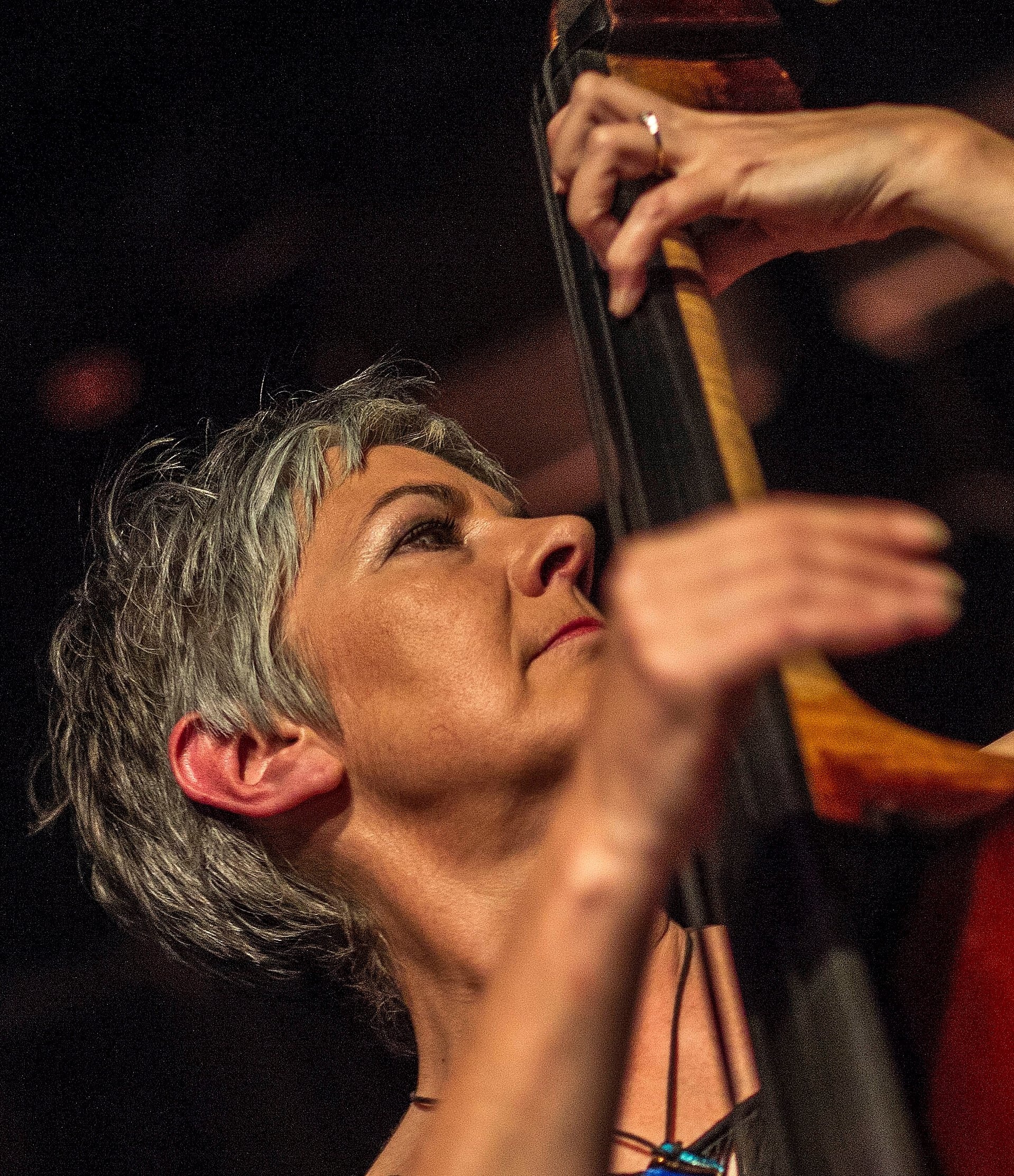
Paula Gardiner is a composer, jazz double bassist and long-standing Ivors Academy member based in Wales. She began her career in classical guitar before moving into theatre, film and TV composition. A self-described “accidental bassist”, Paula discovered her love of jazz through a chance gig – a moment that reshaped her musical path. She went on to lead the jazz course at the Royal Welsh College of Music and Drama and now serves as Deputy Chair of the Jazz+ Council and a representative for Wales.
You’re getting ready to play at this year’s Brecon Jazz Festival – what will you be performing?
I'm playing my 39th Brecon Festival this year, which is quite exciting! I'm debuting a new trio called Double Double – it's me and my daughter Ursula on double bass, with me also on guitar, and Liz Excell on drums. I'm developing a lot of new material at the moment – there's a new sound in my head and I’m trying to get it out. It’s still in progress, but I’ve got about five weeks to pull the full set together!
What are you most looking forward to?
One of the exciting things Brecon Jazz are doing this year is launching a Young Artist stage. I’ve been helping as a volunteer alongside Ursula, who’s programmed a brilliant line-up of young artists from across the UK. We’ve got eight bands on that stage, which I think is fantastic.
There’s so much exciting music coming out of college at the moment, and some of those young artists will be at Brecon too – Nils Kavanagh, Sam Green with Rivers and Lakes, Laurie Rich… all fantastic composers and players. I’m really looking forward to seeing them.
My daughter also has a duet with Sylvie Noble called Ursula and Sylvie – double bass and voice – and they’ve got a new album coming. Ursula was Young Jazz Musician of the Year last year and she’s doing a lot of really creative work. I’m very proud!
Let’s take a step back – how did you first find your way into jazz?
I call myself the accidental bassist because there was a sort of series of coincidences that happened through my early career that saw me morph from a classical guitar player to a jazz double bass player.
In 1979 I was studying classical guitar, but I was very much into writing – in particular for theatre – so worked with quite a lot of the drama students. When I left college, I went to work in a theatre company for a short time as a composer and musical director. It opened the door, and I still work in theatre to this day.
In the early 80s we had our own theatre company and, on one project, we toured 65 different Brains pubs in Cardiff. One day, a member of the company asked me to fill in because their bass player was sick. They had to lend me a bass, and after a rehearsal that afternoon I did my first gig with them that night. They were an Afro-Cuban band and it was just fantastic fun. I was with them for seven years.
Was that your first entry into professional music?
Another member of the theatre company was working with a film director in Cardiff, and we ended up making three 15-minute short films for the first week of broadcast on S4C – the Welsh language TV channel. So I went from working in theatre to suddenly writing for film, and that led to more TV projects and radio dramas.
At the time, I became a member of the APC – the Association of Professional Composers – and not long after, it joined with other guilds like the Writers’ Guild. That’s when BASCA came about. So I’ve actually been with The Ivors since before it was even BASCA!
Did you consider yourself a jazz artist at that stage?
I came into jazz in 1988. The Afro-Cuban band I played in gigged regularly and one night – I wasn’t supposed to be at the gig, as I was lending my bass to someone – I was asked to play in the interval. It was a John Coltrane tune. I said, “I haven’t done any jazz,” and he said, “It’s just four-four notes in a bar and C Dorian mode.” I gave it a go and thought, “This is just fantastic.”
I then signed up for the Porthcawl Jazz Summer School. I heard Mick Hutton playing double bass and thought, “Goodness me – that’s the sound I want to make.” And like all the stories go, you learn the open strings one week at a time and then you get your first gig – and that's literally what happened for me.
How did that affect your creative work?
It changed everything. A little later on it changed my standing in the education world, but it certainly changed my approach to writing and composition. Then I became known for writing jazz scores for theatre plays and everything, so there was a lot of crossover and intermingling.
We’d be out most nights of the week actually, playing benefit concerts in Cardiff. That led to me being asked to play double bass on an album for a Welsh language artist. Then I went on from album to album, artist to artist.
Eventually, in 1995, the record label said, “We’d really like to do a jazz album – we’ve never done one.” They asked me to do that. I had a quartet at the time which I was writing for. That was my first album – Tales of Inclination, with John Parricelli on guitar, Mark Edwards on piano, Ron Parry on drums, and I was on bass and a little bit of guitar.
What advice would you give to early career musicians today?
Be open. Be prepared to be flexible. Say yes. Without the collaborations I've been lucky enough to be in, I wouldn't be doing what I'm doing. You could say it's a bit scary to say yes all the time, but if you can't take a risk early on in your career, then when can you? That's where creativity flourishes – when you give things a go.
You've got to be broad-minded, you've got to be open – especially as a jazz composer and a player. It's a very interactive sport. You’ve got to be open to the input of others – players might interpret your writing quite differently from how you heard it in your head. But that enhances the whole creative moment. The creativity increases as the input increases.
You've been involved with The Ivors Academy for many years – what does that relationship mean to you?
When I joined – and this is still true – I felt very much like you're within a community. And I like that feeling. It's not just you on your own – and especially being in Wales, there’s not that many of us over this side of the border. So having a whole community of writers and like-minded people and being in such a supportive environment... I've always admired those people who were able to speak up and illuminate me as a young writer, for example, on some of the pitfalls and legal battles that were going on, and political battles, as we're seeing at the moment. I always really appreciated that, and I learned a lot – and I still learn a lot – from fellow members at The Ivors.
Tell us about your roles on the Council and Jazz Committee.
I was invited to join the Jazz Committee around 2010. Back then, I’d make the round trip from Wales because it was always worthwhile to meet, exchange ideas and help make decisions that supported others.
COVID was life-changing for me in my relationship with The Ivors. Suddenly everything moved online, and I was able to get more involved. It was empowering, and I think the strength we found working together during that time was a real positive – and something we’ve held onto.
I was then invited to join the Jazz+ Council. The Ivors Academy places a lot of emphasis on making sure the regions are represented, as well as the genres – which is so important. I’m currently Deputy Chair of the Jazz+ Council and I also sit on the Wales Council as a local representative.
What issues are front of mind for you in the music world right now?
One of my concerns is how hard it is to get properly paid these days – across any part of the music industry – for most of us regular musicians. Some of it came out of COVID. There was such a desire to keep things going – people doing remote recordings and similar projects – and that was fantastic. But when things opened up again, everyone wanted to get out and play. In Cardiff, lots of new gigs appeared – which was great – but there isn’t the economic structure to support it. Today, you’re asked to do gigs for a third of what I’d expect in the 1990s.
You used to get commissioned for something. Now you have to pitch – virtually send the finished product just to be in with a shout. And the commission often doesn’t come with enough funding to record with live musicians. There are some great grant opportunities – you can apply to create a new suite, an album, a tour – but they’re few and far between, and very competitive.