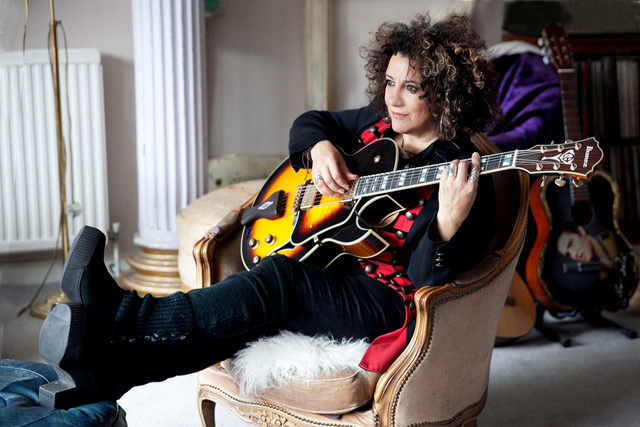
For over three decades, Martha D Lewis has built a distinguished career as a singer, composer and record label director. Her work spans jazz, world music, theatre, film and television, with performances at major international festivals and a longstanding commitment to supporting music creators.
Do you remember when you first realised music was what you wanted to do?
I don't think I chose music. It sounds cliché, but I genuinely think music chose me. I started playing guitar when I was seven years old and I've been performing ever since.
What's always stayed with me is a story about my grandmother, who I was named after. She had a beautiful voice but wasn't allowed to sing because she was a girl. One day, a producer heard her singing and wanted to put her on a record, but her father refused. That record went on to become one of the biggest-selling records in the eastern Mediterranean.
Years later, when my mum wasn't sure what to do with me because I wouldn't stop singing, she wrote to my grandmother. My grandmother wrote back and said: "I was stopped from doing the thing I wanted to do, and I'll take that regret to my grave. Please let Martha sing."
I still carry something she made with me when I perform. I feel incredibly lucky to do what I do because the women before me weren't always given that opportunity.
Have you noticed attitudes towards women in music change throughout your career?
There still isn't parity between women and men in the music industry. Men don't face the same pressures around age and appearance. Women are constantly thinking about how they're perceived, whether they're visible, whether they're ageing "correctly". Those pressures don't disappear.
At the same time, I feel lucky to have experienced a very different music industry. I remember when you could make a living selling CDs, when arts funding was more accessible and there were more opportunities for musicians to learn their craft through performing. When I look at younger artists today, I genuinely wonder how they make it work. It's harder than ever.
One of the biggest turning points in your career came later in life. What happened?
In 2017, I went back to university to study an MA in Songwriting. Before that, I thought I needed the perfect conditions to write. I thought I had to be in the right mood, work with certain people and have everything lined up just right.
Then I started this course and we were writing constantly. Eventually we were being asked to write three songs a day with people we'd never met before. It completely dismantled all the rules I'd built around my creativity.
The biggest lesson was that creativity doesn't arrive because the conditions are perfect. You create because you show up. That experience transformed the way I work and probably led to some of the best music I've made.
Looking back, what have been the biggest turning points in your career?
One thing I've learned is that you don't always know why something is happening when it's happening. I represented Cyprus in Eurovision and we didn't do particularly well. But if I hadn't done Eurovision, I wouldn't have met one of my most important collaborators. If I hadn't met her, I wouldn't have had decades of work that followed.
The older I get, the more I believe that the doors that close are just as important as the doors that open. When something doesn't happen, it doesn't necessarily mean you've failed. It might simply mean there's another path waiting for you that you can't see yet.
What concerns you most about the future of music?
AI is changing everything. I'm not anti-technology, but I am concerned about what happens when music becomes detached from the people who create it.
Human beings need stories. They need connection. They need to know that another person has lived something and turned it into art. When people listen to music, I want them to think about where it came from and who made it. If we want human-made music to survive, we have to support it. We have to go to gigs, support artists and understand the value of creativity. Music isn't just content. It's part of what makes us human.
What's one small joy of the job?
Music itself. Whether it's listening, creating, performing or discovering something new. Music is joy.
What's one hard truth of the job?
Don't measure yourself against what the industry values. Success isn't just sales, streams or awards. A great piece of music is still a great piece of music, whether it reaches ten people or ten million.
As a member of The Ivors Academy's Jazz+ Council, you've been instrumental in championing new voices through UK Jazz Plus. Why was that important to you?
When we first started the Jazz Council, we realised so many artists didn't fit neatly into one box. We talked about calling it the Jazz and Blues Council, or Jazz, Blues and Soul, but it quickly became clear that so many musicians were creating something much broader. That's how the name Jazz + Council at The Ivors Academy was born.
I then went on to create and direct UK Jazz Plus, for artists whose music is rooted in jazz but blends other influences - soul, folk, electronic, world music, whatever reflects who they are. They're creating beautiful, original work that doesn't always fit traditional ideas of what jazz should sound like.
Through UK Jazz Plus, I've wanted to use whatever influence I have to open doors for those artists. We started with a festival during the EFG London Jazz Festival, then went on to work with venues including the Southbank Centre, Rich Mix, PizzaExpress Live and now Ronnie Scott's.
What makes me proud is seeing programmers recognise that jazz is evolving.
There are so many incredible musicians telling contemporary stories through this music, and they deserve platforms just as much as anyone else. That's what UK Jazz Plus is about – celebrating artists who don't fit into a box and giving them the opportunity to be heard.
Watch Martha D Lewis at Crazy Coqs Piccadilly on Saturday 26 September at 19:00.